

Updated September 2026
Thinking about quitting teaching mid-year?
Established in 2019, Teacher Career Coach is a community sharing honest advice for teachers considering new careers. Featured in WSJ, NPR, and Yahoo News, 10k former teachers have used our resources to get new roles.

If you’re thinking about quitting teaching mid-year, you’re not alone, and you’re not a bad teacher for considering it. Teaching is one of the few careers where wanting to leave in the middle of the year comes with this much stigma, this many hoops and this much fear about what happens next.
I want to walk you through what actually happens, what the rules look like in your state and how I’d think about the decision in 2026.
Please note: I am not a licensed attorney or a legal expert, and this isn’t legal advice. Rules change and vary by district and contract. Read your contract carefully and check with your union representative or HR before you act.
I know that breaking point
One day when I was teaching, I had to leave abruptly in the middle of the school day because I started sobbing uncontrollably at recess. I just couldn’t control it.
So I understand why so many teachers search for a way out before the year is over. In my case, I waited until the very end of the school year and started applying right around April. I also told my principal I was applying, because I knew they needed time to fill my role.
That was the right path for me. It may not be the right path for you. But it’s why I care so much about helping you make this decision with clear eyes.
Should you quit teaching mid-year in 2026? My honest take
I’m going to be honest and blunt here: in 2026, it’s taking much longer to land a role outside the classroom than it did a few years ago. From what hiring managers are telling me and from my own research, the market isn’t getting better by the end of this year.
Our own survey data backs that up. One recent career changer told us, “In this market, I wouldn’t leave my job unless I had something else lined up as it’s taking most people 6 months to a year to find a role.”
Landing a new role is taking longer
Share who hadn’t landed a non-teaching role by the time they took our 2025 survey
Source: Teacher Career Coach 2025 Job Market Survey.
I’m a person who likes to plan with an abundance of caution. I would never break my contract until I had another job lined up, and especially not right now. If I were in your shoes and struggling, I’d use as many of my sick days as I could and find a therapist to help support me while I planned my exit.
That being said, I can’t make this decision for you. Only you know your situation, your comfort level with risk and what’s driving you to leave mid-year. For some people, staying truly isn’t an option, and that’s valid too. If that’s you, the rest of this guide is here to help you leave as safely as possible.
What happens if you quit teaching mid-year?
A teaching contract is a legal agreement. If you leave before it ends without the district formally releasing you, these are the most common consequences:
Your license could be suspended
Anything from a reprimand to a suspension of a year or more, depending on your state. Some states treat it as an ethics violation.
You could be fined
Some contracts include “liquidated damages.” One of our course members was fined $1,500. Colorado caps it at the lesser of replacement costs or 1/12 of your salary.
You may need to stay until they replace you
Some districts release you only once your position is filled, which can take a while in shortage areas.
Your references and reputation
Education is a small world, and so are many of the industries teachers move into.
What actually happens varies a lot. One member in Maryland told us their state suspends licenses when a contract is breached. Another in North Carolina said there were no repercussions after giving 30 days’ notice. Others were threatened with serious penalties that never came. That’s exactly why you need to check your own state and contract.
Quitting teaching mid-year: rules by state
Here’s what state law says in 15 of the largest states, as of September 2026. Many of these rules apply only to tenured or continuing-contract teachers. Charter schools often follow different rules. Always confirm with your union rep, HR or your state’s educator licensing agency.
Mid-year resignation rules in 15 states
| State | Notice rules | Possible license consequence |
|---|---|---|
| Arizona | Once you sign and return your contract, you need governing board approval to resign. | Resigning anyway is considered unprofessional conduct. The State Board can suspend or revoke your certificate. |
| California | No set notice period in state law. | Suspension is possible, capped at one year for a first offense. Per a 2025 legal memo, first suspensions often run 7–14 days. Districts can sue for damages but rarely do. |
| Colorado | 30 days’ notice before your last day mid-year (or 30 days before the school year starts). | License suspension is possible without good cause. Damages are set by law: the lesser of replacement costs or one-twelfth of your annual salary. |
| Florida | Check your contract. | Leaving without the school board’s release can lead to discipline ranging from probation to suspension. |
| Georgia | Check your contract. | Breaching a contract is an ethics violation. The Georgia Association of Educators says a 90-day suspension is typical. Fines apply only if your contract includes them. |
| Illinois | Tenured teachers need board agreement or 30 days’ written notice. You can’t resign mid-term to take another teaching job without board agreement. | That violation means a mandatory one-year license suspension. |
| Maryland | Tenured teachers give 30 days’ written notice, traditionally by July 15. | Up to a 365-day suspension for leaving without board consent, unless there’s an emergency. (This rule was being updated in 2026.) |
| Michigan | Tenured teachers need mutual consent or notice at least 60 days before September 1. | You lose tenure. We found no state license penalty. |
| New Jersey | Tenured teachers give 60 days’ written notice unless released sooner. Non-tenured teachers need board consent to leave early. | Up to a one-year suspension, and one year is the presumed penalty. |
| New York | 30 days’ written notice. | Check with your union. |
| North Carolina | 30 days’ notice to resign mid-year without the superintendent’s consent. | Your board can ask the State Board to revoke your license for the rest of the school year. |
| Ohio | You need board consent to resign after July 10 or during the school year. | Up to a one-year suspension. |
| Pennsylvania | 60 days’ written notice under the standard contract. | Resigning isn’t listed as a ground for state discipline. |
| Texas | You can resign penalty-free up to 45 days before the first day of school. After that, you need board consent. | Leaving mid-year without good cause means at least a one-year certificate suspension. Good cause includes serious illness (yours or a close family member’s) and certain relocations. |
| Virginia | After June 15, you need approval and must request release at least two weeks ahead, with a reason. | If you’re denied and leave anyway: a reprimand, suspension or revocation is possible. |
Sources: state education codes and licensing rules, last checked September 2026. See the full source list at the end of this post.
What counts as “good cause” to break a teaching contract?
Many districts and some states will release you, or reduce the penalty, for reasons like these. Check whether they’re written into your contract, or ask your union rep or HR:
- Your physical health. You may qualify for medical leave, which can be a safer option than resigning.
- Your mental health. Your well-being should never come at the cost of any job. Depending on your situation and your doctor’s recommendation, you may be eligible for a leave of absence or a release.
- Family needs. Caring for a seriously ill family member, or a significant change in your family’s needs.
- Relocation. For example, when a spouse or partner’s job moves you out of commuting distance.
One thing you won’t usually see on that list: a new job offer. Taking a new job with better pay may be exactly what you need, but a better offer generally isn’t considered good cause. In Illinois, leaving mid-term for another teaching job without board agreement triggers a mandatory one-year suspension.
Contract vs. letter of intent
If you’re worried about backing out before the school year starts, check how far along you actually are. A signed contract is legally binding. A letter of intent generally isn’t, though some consider it ethically binding. Either way, handle it professionally so you don’t burn bridges.
How to quit teaching mid-year (if you decide to)
- Read your contract. Look for the notice period, any liquidated damages and how release requests work.
- Talk to your union representative. There may be another way out, like a leave of absence. (Listen to episode 15 on getting support from your teachers union.)
- Get your finances ready. Financial experts commonly recommend having at least six months of necessary expenses saved if you’re leaving without another job lined up.
- Request a release in writing. This is usually addressed to the superintendent or HR. Be professional and clear. It isn’t a guarantee, but it’s the step that protects you most. (Here are 6 tips for writing a teacher resignation letter.)
- Have the conversation face-to-face. Share your intended last day and ask what you can do to ease the transition.
- Offer a transition plan. Lesson plans, notes on students and a handoff for whoever steps in. Your colleagues will likely be covering for you, and this matters.
- Don’t burn bridges. Whether you stay in education or leave it entirely, you never know which connections will open doors later.
If you decide to stay until the end of the year
Staying doesn’t mean doing nothing. I want you to use the rest of this year to protect yourself and get ready:
- Use your sick days. That’s what they’re there for.
- Get support. A therapist can help you get through the rest of the year. (Listen to episode 31: Therapy for Teachers.)
- Start your job search now, quietly. Figure out which roles fit your numbers, update your resume and start networking. Then begin applying about two months before your last day. (See the career transition timeline for teachers.)
- Let go of the guilt. Whether you leave in December or June, wanting something different for your life is okay. (Read battling teacher guilt about leaving the classroom.)
Still deciding whether to leave at all? Start with why teachers quit and how to know if it’s time for you.
Frequently asked questions about quitting teaching mid-year
Can a teacher quit in the middle of the school year?
Yes, but leaving without the district’s release can have consequences depending on your state and contract, including license suspension or fines. The safest approach is to request a formal release in writing and follow your state’s notice rules.
Will I lose my teaching license if I quit mid-year?
You might, depending on your state. Illinois, New Jersey and Ohio can suspend a license for up to a year, and in Texas it’s at least a year. Georgia typically suspends for about 90 days, and California’s first suspensions are often short. Pennsylvania doesn’t list resigning as a ground for discipline. If your district formally releases you, these penalties generally don’t apply.
Can my school district fine me for breaking my contract?
Only if your contract or state law allows it. Many contracts include “liquidated damages” clauses, often tied to the cost of replacing you. Colorado is one state that sets the amount in law. Check your contract or ask your union rep.
Do teachers have to give two weeks’ notice?
Often it’s longer. Many states and contracts require 30 to 60 days’ written notice, and some require board approval to resign during the school year at all.
Can I quit teaching mid-year for mental health reasons?
Health concerns are among the most commonly accepted reasons for a release or a leave of absence. Talk with your doctor, then with HR or your union rep, about a medical leave before you resign. It may protect your license, your income and your benefits.
What’s the best time of year to resign from teaching?
At the end of your contract, with notice given before your state’s deadline. Many teachers start applying for new roles in the spring and time their start date for the summer.
Whatever you decide, please don’t beat yourself up. We are so conditioned to put everyone else’s needs first. You’re allowed to put yourself first too.
You don’t have to do this alone
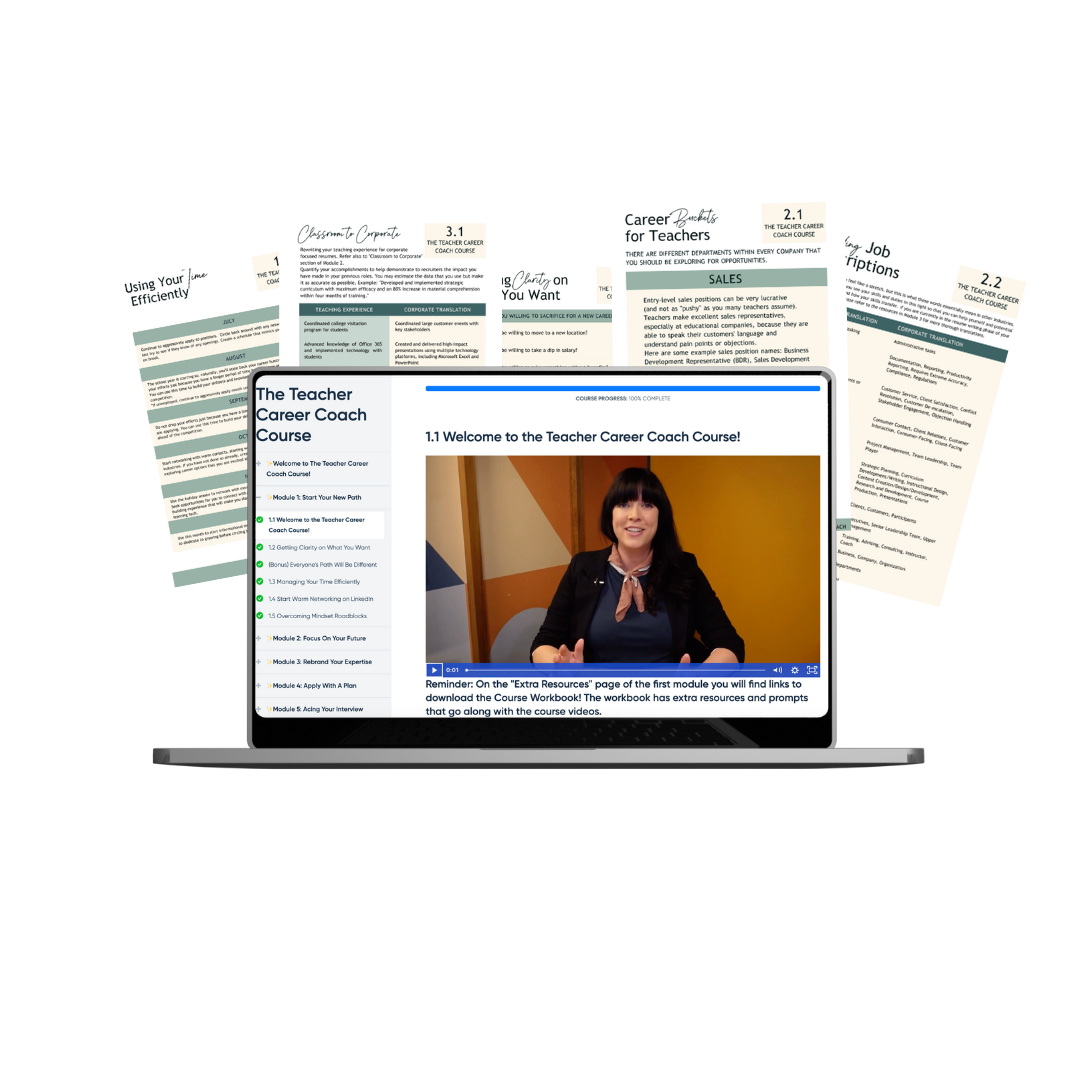
If you’re planning your exit and don’t want to do it alone, the Teacher Career Coach Course walks you through every step: picking a path, translating your resume, networking and interviewing, so you can line up your next role before you leave.

Sources for the state table
AZ: A.R.S. §15-545 · CA: Educ. Code §44420 and Schools Legal Service memo (2025) · CO: C.R.S. §22-63-202 · FL: Rule 6B-11.007 and F.S. §1012.33 · GA: GaPSC Rule 505-6-.01 · IL: 105 ILCS 5/24-14 · MD: COMAR 13A.12.06.02 · MI: Teachers’ Tenure Act · NJ: N.J.S.A. 18A:28-8 · NY: Educ. Law §3019-a · NC: G.S. §115C-325.9 · OH: ORC §3319.15 · PA: 24 P.S. §11-1121 · TX: Tex. Educ. Code §21.210 and 19 TAC §249.17 · VA: Va. Code §22.1-304