

Updated September 2026
Why do teachers quit, and is it time for you?
Established in 2019, Teacher Career Coach is a community sharing honest advice for teachers considering new careers. Featured in WSJ, NPR, and Yahoo News, 10k former teachers have used our resources to get new roles.

Whether you should quit comes down to three things: how long you’ve felt this way, whether there’s an “easier fix” (like a different school, grade, or district) that could fix how you feel, and how your financial numbers work outside the classroom.
If you’re reading this, you’re here because you’re facing a really hard decision and you may want someone to make it for you.
I want to be upfront with you: I can’t make this decision for you, only you can. And you shouldn’t trust anyone claiming leaving is the right move for everyone, because there isn’t a one-size-fits-all answer for this.
What I can do is give you the real reasons teachers leave, the honest data on what happens after, and the questions I’d recommend you to answer before you decide.
I was one of the leaving teaching statistics.
I left my classroom within my first five years of teaching. I knew for a while that something was “off.” My mental health was struggling even after I tried changing districts. And even though I knew it was the right choice, I want to be honest here, leaving the classroom was one of the hardest things I’d ever done.
But pushing through that struggle set me up to keep doing hard things, in my career and in my personal life. I had incredibly low self-esteem when I started the journey after a toxic school environment made me feel extremely devalued. But my confidence kept slowly growing after I found myself in roles where I thrived. I went on to work for companies like Microsoft and GoGuardian, and eventually to run my own company with six employees.
I’m not telling you that because my path is the one you should take. I’m telling you because the version of me sitting in that classroom sobbing that I wasn’t good enough for anything couldn’t picture any of what would come next.
Why are teachers quitting? What the 2026 data says
18%
of teachers intended to leave their jobs at the end of the 2025–26 school year
55%
reported frequent job-related stress, down from 62% in 2025
$75,599
average teacher base salary, vs. $105,000+ for similarly educated professionals
6.7%
teacher turnover in 2024–25 (about 6% before the pandemic; 11.1% in urban districts)
What stresses teachers most
Share of teachers naming each as a top stressor
Sources: RAND State of the American Teacher, 2026 and RAND American School District Panel, 2026. Only 39% of teachers got a raise that kept up with inflation, and teachers spent $665 of their own money on supplies on average.
Numbers only tell part of the story, though. Here’s what it looks like from inside the classroom.
The biggest reasons teachers quit
More than 1,000 teachers have told me in Teacher Career Coach surveys why they left or want to leave. The same themes come up again and again. Just know that almost nobody’s reasons fit neatly into one bucket.
1. Stress and burnout
This is the one I hear most, and it’s the one I lived.
In my last year of teaching, I worked most weekends. I skipped birthday celebrations to grade. I skipped a trip to Hawaii with my fiancé’s family to prepare for parent-teacher conferences. And I never felt like I was doing enough to be a “good teacher”.
I was in the doctor’s office on a regular basis. Eventually they tied my clenched jaw, my new (and frequent) headaches and my stomach issues to work-related stress. After I left, those symptoms drastically improved and I slowly came back to myself.
There’s been many teachers who left who said the same. One we spoke with put it this way: “I couldn’t continue for 15 more years with the level of stress I was putting on myself.”
Teacher burnout can show up in year one or year twenty-five, but the impacts on your health are worth taking seriously if it’s happening to you. (If you want to dig into what’s behind it, read the causes of teacher burnout.)
2. Student behavior
About half of teachers in RAND’s 2026 survey named managing student behavior as a top stressor. Our survey respondents describe the same shift since the pandemic: “Teaching has become unsatisfying because now it entails putting out fires and teaching self-regulation.”
Wanting to leave because of this doesn’t mean you don’t care about kids. Many teachers who leave loved their students and are grieving the job they signed up for.
3. A toxic climate and a lack of support
Micromanagement. Little autonomy. Initiatives that change every year. A lack of respect from administration, parents or the school board. Teachers feel valued and motivated in supportive environments. Take that away and even people who love teaching start to burn out.
Our survey respondents often say it in five words: “Burnout, toxic school environment, unrealistic expectations from admin.”
4. Pay that doesn’t match the hours
I could barely make rent in Los Angeles on my teacher’s salary, with a master’s degree. I didn’t go into teaching for the money. But after a few years of scrambling to pay my student loans, I knew something had to change.
That said, low pay alone usually isn’t the whole story. It’s low pay plus nights and weekends plus constant stress that pushes people over the edge. (Wondering how the pay really compares? Read will I make more than my teacher salary?)
5. No room to grow
Inside a school district, the main path up is administration. If that’s not what you want, you can end up at a career standstill for decades, with professional development that doesn’t touch your real pain points.
And not everyone who leaves is burned out. Some teachers just want a new challenge and a path forward. That’s a valid reason too.
6. Politics and outside pressure
Curriculum mandates, state laws and feeling like you can’t do your job the way you know it should be done come up more and more in our surveys. One respondent summed up why she was leaving as “politicians dictating our curriculum.”
If your reason isn’t on this list, it still counts. Leaving teaching is a personal choice, and you don’t owe anyone a reason that fits in a headline.
Should I quit teaching? How to know it’s time
I’m going to be honest and blunt here: you’ll never feel ready to quit. And especially right now, the job market might never feel ready either.
It might not be what you want to hear, but I will never be the person who tells you it’s easy to match a $100k+ teaching salary with a role outside the classroom in 2026. In our most recent survey data, exactly one person in the latest group of career changers started above $109k.
So instead of waiting to feel ready, I want you to get clear on your numbers:
- Know the starting salaries for the jobs you’re considering. In our 2025 survey of 722 former teachers, Learning & Development roles started highest, around $72,700 on average. Customer Success and Sales started lower but grew fastest. (More in my episode all about salary.)
- Know your own number. What does your budget actually need, based on your cost of living? What would you give up in pension or benefits? (Start with should you stay for your teaching pension? and how one former teacher got out of $100K in debt.)
- Work backward to the careers that fit, and what it takes to get them. Once you know your number, you can see which roles meet it now and which could meet it in a few years. (Take the career quiz or read the career transition timeline for teachers.)
Signs it may be time to leave teaching
- You’re exhausted far more often than you’re energized. Everyone has rough days. But if you’re drained 179 out of 180 days, treat that as a flashing neon sign.
- The Sunday scaries start on Saturday. If you can’t bear the thought of another week, your heart may no longer be in it.
- The stress comes home with you. In my last year, I felt like I was going to lose my boyfriend. When we did have time together, I was grumpy and drained. (Luckily, he stuck around.)
- Your health is paying for it. No career is worth losing your sense of self or your health.
- You’ve felt this way for years, not just this year. If you search “other jobs for teachers” every spring, you’ve probably had one foot out the door for a while.
- You’ve already tried a different school, grade level or administrator, and it didn’t help.
- The spark is gone, and negativity is creeping in. If you notice yourself spreading frustration to colleagues or students without meaning to, that’s worth paying attention to.
- You can’t make the finances work. If your cost of living means struggling for years on a teacher’s salary, that’s a real reason.
- You simply want something different. You don’t have to be the same person you were 5, 10 or 15 years ago. You went into teaching because you have a good heart. You still have one if you leave.
Signs it might be the school, not the career
I don’t want anyone who loves teaching to walk away because of one terrible year. Before you decide, I want you to ask yourself:
- Did these feelings start this year, or have they been building for years?
- Is the problem mostly one administrator or one school’s culture? A neighboring district, a charter or a private school might feel completely different.
- Would a different grade level or subject remove your biggest stressor?
If a change of setting could help, it’s worth trying. Worst case, you walk away later knowing you gave it everything. I talk through this in more depth in podcast episode 20: Should I Leave Teaching? The Pros and Cons.
What happens after teachers quit? Honest data from 722 former teachers
Every year I survey former teachers about what they actually landed and what it paid. Here’s what 722 of them told us in our 2025 Job Market Survey:
94%
said work-life balance was better or much better after leaving
553
different job titles. Not ten.
+21%
average pay increase (about $13,900) from where they started
25%
said networking or a referral got them hired, vs. 16% resume tailoring
Pay after leaving, most recent career changers
Compared with their teaching salary
Source: Teacher Career Coach 2025 Job Market Survey (722 former teachers). Fully remote roles also dropped from 44% to 34% for this group.
It’s harder right now
Share who hadn’t landed a non-teaching role by the time they took our survey
I say this from a place of love: it is harder for career changers right now.
Harder. Not impossible. It may mean upskilling, starting at an entry-level role, looking at in-person jobs or widening your search beyond EdTech. Difficult has never meant impossible.
If you decide to leave: where to start
- Run your numbers first. Know the salary you need before you fall in love with a job title.
- Narrow your options. “I don’t know what I want to do” is one of the most common places teachers get stuck. The quiz below is a free place to start.
- Start networking before you need it. Warm contacts first: friends, former colleagues, friends of friends. (Here’s networking advice for career changers.)
- Don’t wait until summer to apply. Hiring often takes six to eight weeks, and the biggest mistake I see is waiting until the last day of school to start. If you need to leave sooner, read about quitting teaching mid-year and breaking your teaching contract first.

If you decide to stay
There is absolutely nothing wrong with staying. But please don’t accept “it is what it is.” Look for support that fits what you’re struggling with: a new school, a mentor, a community of teachers who get it, or tools to manage stress from teaching.
And if you’re really struggling day to day, talking with a therapist may be the most important first step. You can hear more in episode 31: Therapy for Teachers.
Frequently asked questions about quitting teaching
Why are so many teachers quitting?
The most common reasons are stress and burnout, student behavior, low pay relative to hours worked, lack of administrative support and limited career growth. In RAND’s 2026 survey, the top stressors were managing student behavior (about 50%), low salary (33%) and hours worked (32%).
What percentage of teachers quit in the first five years?
Estimates vary depending on how “leaving” is counted. The widely cited figure from researcher Richard Ingersoll is up to 44% within five years, while a federal study that followed new teachers found about 17% had left the profession after five years. Either way, turnover is highest among newer teachers.
Is it normal to want to quit teaching?
Yes. Nearly one in five teachers said they intended to leave their jobs in 2026, and many more think about it. Wanting to leave doesn’t make you a bad teacher or mean you don’t care about your students.
Will I take a pay cut if I leave teaching?
You might, at first. In our 2025 survey, 53% of the most recent career changers took a pay cut and 36% got a raise. Former teachers reported an average increase of about 21% after their first non-teaching role, so the starting salary isn’t the whole picture.
What jobs do teachers get after quitting?
Our survey respondents reported 553 different job titles. The most common areas were learning and development (including instructional design and corporate training), customer success, sales, marketing and nonprofit work, plus project management, operations, higher education and healthcare roles. See second careers for teachers for more.
Can I quit teaching in the middle of the year?
Sometimes, but there can be consequences depending on your contract and state. Read quitting teaching mid-year and breaking your teaching contract before you decide.
If you’ve read this far and still don’t know what you want to do, please don’t beat yourself up. Clarity comes in waves. You don’t have to have the whole plan today. You just need the next step.
Ready for your next step?
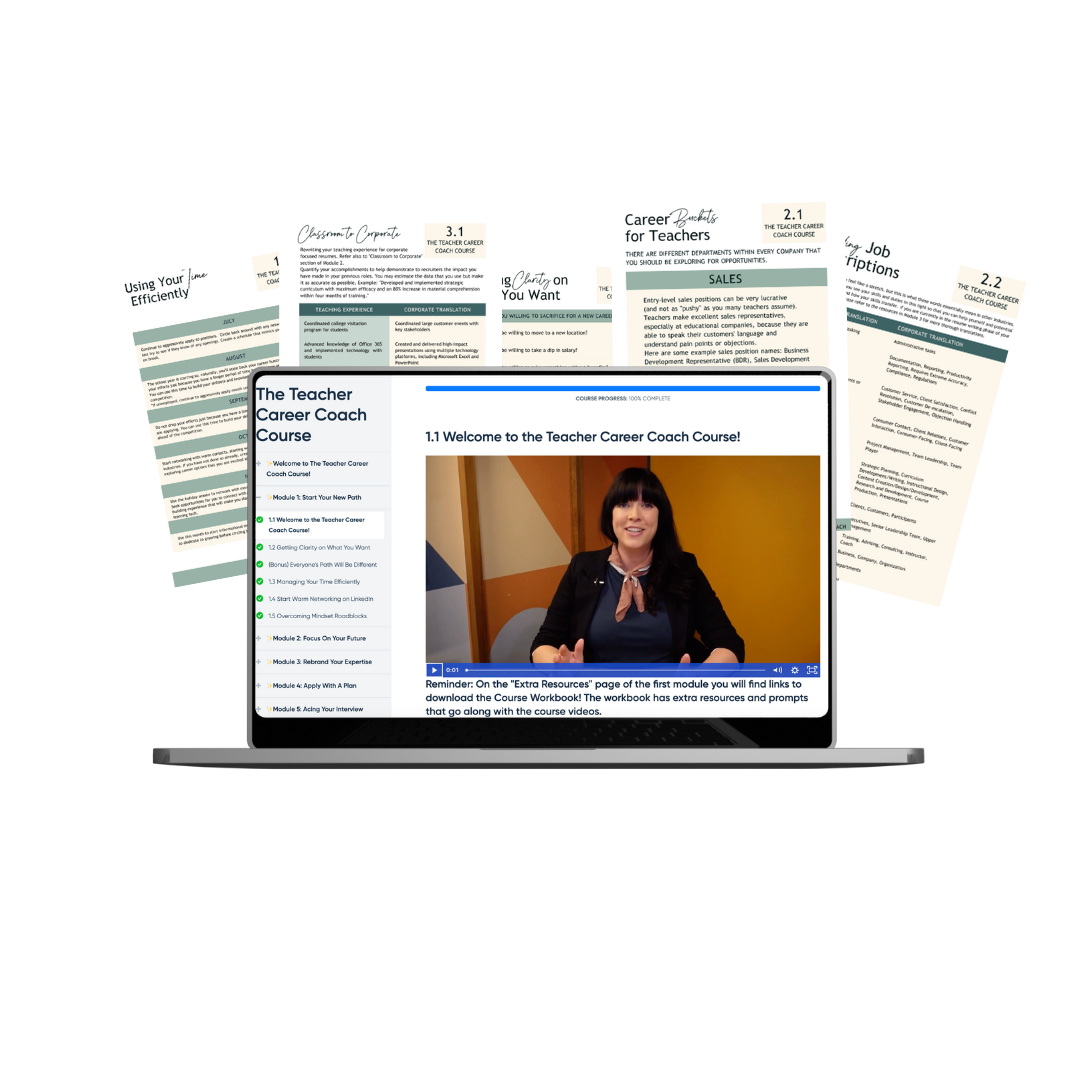
If you’re ready to leave and don’t want to figure it all out alone, the Teacher Career Coach Course walks you through every step: choosing a path that fits your numbers, translating your resume, networking and answering interview questions.
Whatever you decide, I’m rooting for you.