
Updated September 2026
What jobs do former teachers actually get?
Established in 2019, Teacher Career Coach is a community sharing honest advice for teachers considering new careers. Featured in WSJ, NPR, and Yahoo News, 10k former teachers have used our resources to get new roles.

I left my classroom in 2017. My first role out was as an educational consultant. I went on to work in Microsoft’s education department and as an instructional designer at GoGuardian, and eventually to run my own company.
Back then, I searched for what former teachers actually did next and found a wall of “10 jobs for teachers!” lists with no real numbers attached. So every year, I survey former teachers about what they landed and what it paid. This guide is built on those answers, not guesses.
What 722 former teachers actually landed
In our 2025 Job Market Survey, 722 former teachers reported 553 different job titles. Here’s how the most common categories compared:
Average starting salary by career category
722 former teachers, 2025 TCC Job Market Survey
Salaries were reported in bands, so averages are estimates.
How much pay grew after landing
Average increase since their first non-teaching role
Share who feel their job is safe: Sales 64%, Customer Success 61%, Other 60%, L&D 58%, Nonprofit 55%, Marketing 54%.
94%
said their work-life balance was better or much better after leaving
1 in 2
recent career changers landed outside the “classic” teacher paths, in roles like PM, operations, admin, higher ed and healthcare
25% vs 16%
credited networking or a referral for getting hired, vs. resume tailoring
What’s changed for teachers leaving in 2026
I’m going to be honest and blunt here: it’s taking longer to land a role outside the classroom than it did a few years ago. Two shifts matter most when you’re choosing a path.

1. AI is changing instructional design
I’m nervous about instructional design right now. In August 2026, Adobe released a beta tool inside Adobe Learning Manager that can generate a complete course (lessons, images, knowledge checks and quizzes) from a prompt or uploaded documents. I’d watch hiring trends closely in 2027.
Our survey already shows the shift: learning and development dropped from 31% to 22% of where recent career changers landed, and Articulate, the go-to course-building tool, fell from the #2 most-used tool to #15.
Where recent career changers landed: L&D
Share of new roles in learning and development
Source: Teacher Career Coach 2025 Job Market Survey.
I don’t think learning how to build an Articulate or Adobe course step by step will be the skill that helps someone stand out for the role anymore.
2. Employers want AI skills
EdTech is still hiring, but in 2026 I’ve noticed many of the roles looking for former teachers now ask for AI skills as well. You may need to upskill there, whichever path you choose. (More on how below.)
The best jobs for former teachers in 2026
These are the paths I’d look into first right now. Salary examples come from former teachers in our audience.
1. Customer Success Manager
Customer success (not to be confused with customer support, the “help desk”) is a proactive, relationship-building role. You make sure customers are happy and getting the most out of a product: onboarding new clients, running trainings and check-ins, and making sure they renew. At an education company, you already know your customers’ needs and objections before they say them.
Why it fits: relationship building, empathy, problem solving and training. In our survey, customer success pay grew about 30% after landing, and 61% felt their job was safe.
Real titles and salaries: Customer Success Associate ($60,000) · Customer Success Manager ($73,000) · Associate Customer Success Manager ($80,000)
Learn more: Podcast Episode 102: Megan Wardwell, From Teacher to Customer Success. You can also check out Aspireship to learn customer success skills.
2. Sales (Sales Development Representative, Account Executive)
Don’t be afraid of sales. At many companies, especially in education, sales is less about pushing and more about matching the right product to the right customer, like the right curriculum for a school’s needs. The work includes research, outreach, updating a CRM (customer relationship management) system, scheduling meetings and running product demos.
Why it fits: if you love building relationships, beating your own data and creating your own opportunities. Sales pay grew the fastest in our survey, about 36% after landing (and that’s base salary, before commission).
Real titles and salaries: Sales Development Representative ($46,000 + commission) · Inside Sales Consultant ($65,000 + commission) · Education Sales Consultant ($60,000 + commission, roughly $100,000 total)
Learn more: Podcast Episode 57: A Career in Sales Isn’t Scary. Aspireship also teaches the skills to become a Sales Development Rep.
3. Project Manager
Project managers keep a team’s work on scope, on budget and on time. They plan timelines, assign tasks, remove roadblocks and report progress to leadership, usually using project management software.
Why it fits: if you love planning big projects, building structured timelines and keeping people accountable. Project management was one of the roles our respondents felt safest in.
Real titles and salaries: Project Manager ($60,000) · Project Manager ($85,000) · Project Manager ($100,000)
Learn more: Podcast Episode 103: Carol Cobb, From Teacher to Project Manager.
4. Operations, Administrative or Executive Assistant
If you’re the teacher with the organized desk, the seamless filing system and zero missed deadlines, you’d make a great assistant or operations professional. Assistants keep an office, department or executive on track: calendars, travel, meetings, invoices and communication. These roles can also be a stepping stone into operations or project management.
Real titles and salaries: Office & Project Assistant ($58,000) · Administrative Assistant ($65,000) · Executive Assistant ($67,000)
Learn more: Podcast Episode 115: Kayla Dunne, Leaving Teaching With Small Children.
5. Human Resources or Recruiter
HR handles hiring, onboarding, benefits and the day-to-day people side of a company. Recruiting, a branch of HR, focuses on finding candidates, running screening calls and guiding people through interviews.
Why it fits: strong people skills, organized records, handling conflict and communicating with families from every background.
Real titles and salaries: Recruiting Coordinator ($55,000) · Recruiter ($60,000) · Human Resources Specialist ($68,000)
Learn more: Podcast Episode 27: Katelyn Samuels, From Teaching to Human Resources.
6. Corporate Trainer and Learning & Development
Corporate trainers design, deliver and evaluate training for a company’s employees, in person, over Zoom or Teams, or through e-learning. It’s one of the most natural fits for teachers, and in our survey, learning and development paid the most to start.
I’d still look into learning and development roles. Just be mindful of the changes AI is bringing, and lean into the parts that are hardest to automate: facilitating live training, coaching people and figuring out what a team actually needs.
Real titles and salaries: Corporate Trainer ($69,000) · Learning & Development Specialist ($85,000) · Regional Trainer ($88,000)
Learn more: Podcast Episode 32: Corporate Trainer Roles.
7. Higher Education
If you still want to support students, just in a different setting, colleges have many roles beyond teaching: academic advising, admissions, student affairs and program management.
Real titles and salaries: Student Services Coordinator ($45,000) · Student Services Coordinator ($53,000) · Educational Advisor ($60,000)
Learn more: In-Person and Remote Higher Education Jobs.
8. Nonprofit and Museum Education
Nonprofits need people for program coordination, community outreach, fundraising, grant writing and management. Museum educators create learning experiences around a collection, coordinate tours and build programs for visitors of every age.
Nonprofit work is worth looking into. Just go in with eyes open: in our survey, about a third of nonprofit respondents felt their job was at risk, and every one of them named federal or grant funding cuts, not AI.
Real titles and salaries: Recruitment & Outreach Coordinator ($55,000) · Director of Programming ($60,000) · Education Specialist, Children’s Museum ($46,000) · Education Outreach Manager ($55,000)
Learn more: Podcast Episode 96: From Education to Nonprofit and Episode 98: From Teaching to Museum Education Management.
9. Marketing
Marketing includes content creation, social media, email, events, copywriting and analyzing what’s working. If you loved writing the class newsletter or designing the classroom website, marketing might be a fit.
Real titles and salaries: Marketing Coordinator ($55,000) · Marketing Specialist ($75,000) · Director of Marketing & Training ($110,000)
Learn more: Podcast Episode 124: Why This CEO Wants Teachers for Marketing Roles. Aspireship also offers training for B2B marketing.
Paths to approach with caution in 2026
These can still work. They just take more upskilling, a stronger portfolio or more patience than they used to.
10. Instructional Design
Instructional designers create e-learning and training for companies: meeting with subject matter experts, assessing needs, storyboarding and building courses. It was one of the most popular paths for teachers, and it’s also one of the most competitive. As one recent career changer told us, “Entry level roles in Instructional Design are very competitive… you can’t hop into it the way people did during the pandemic.”
If you pursue it, focus on what AI can’t do well: understanding the learner, working with stakeholders and measuring whether training actually worked.
Real titles and salaries: Instructional Designer ($65,000) · Instructional Designer ($73,000) · Instructional Designer & eLearning Developer ($85,000)
Learn more: Podcast Episode 123: Adjusting to Corporate Life as an ID.
11. Curriculum Writer
Curriculum writers research and develop lessons, assessments and materials for schools, publishers and education companies. There are often contract and freelance options. Like instructional design, content production is an area where AI is moving fast, so pair your writing skills with subject expertise and editing judgment.
Real titles and salaries: Curriculum Designer ($60,000) · Curriculum Developer ($83,000) · Content & Curriculum Math Specialist ($90,000)
Learn more: Podcast Episode 112: Contract Positions in EdTech.
12. Software Engineer
Software engineering pays well, but it requires significant upskilling in programming. One recent career changer in our survey put it plainly: “Bootcamps used to be an effective way to get a tech job… nowadays not so much.”
Real titles and salaries: Frontend Software Engineer ($80,000) · Associate Software Engineer ($110,000) · Software Engineer ($115,000)
Learn more: Podcast Episode 6: From Teacher to Software Engineer.
13. UX Designer
UX (user experience) designers research how people use websites and apps and design experiences that are easy and enjoyable. It’s a creative, empathetic fit for some teachers, but it requires real upskilling and a strong portfolio to break in.
Learn more: Podcast Episode 55: From Teacher to UX Designer.
You don’t have to work at an education company
One misconception I see a lot is that teachers think they can only get hired at education companies. That’s not the case. Sales, customer success, project management, operations and HR exist in almost every industry. Our recent career changers landed in staffing and recruiting, finance, insurance, government, healthcare and tech, not just EdTech.
The key is translating your experience for the role you want, not the role you had. Instead of “planned and delivered lessons for 32 students,” a corporate resume might say “Designed and delivered training for 32 learners, using data to track progress and adjust instruction.” (Here are 4 tips for translating your teacher resume.)
How to build the AI skills employers are asking for
You don’t need to become a tech expert. You need to be comfortable using AI in everyday work (research, writing, planning and organizing information) and able to talk about how you’ve used it. Two beginner-friendly places to start:
Two beginner-friendly places to start
- Google AI Professional Certificate: about 8 hours on using AI for research, writing, content creation and data analysis. No coding required.
- Real-World AI with Claude: a beginner series from Anthropic, the company behind Claude. It covers prompting, organizing your work with AI and automating repetitive tasks. You can take it for free, or pay for a certificate to add to your resume and LinkedIn.
I may earn a commission if you sign up through these links, at no extra cost to you.
Just know that a certificate alone won’t set you apart. What will is using what you learn on something real, like a sample training, a customer email sequence or a project plan you can walk through in an interview.
How to choose your next path
- Know your number. Figure out what salary your budget actually needs before you fall in love with a job title. (See will I make more than my teacher salary?)
- Narrow it down. “I don’t know what I want to do” is one of the most common places teachers get stuck. Our free quiz below is a good place to start.
- Talk to people in the role. Networking was the #1 thing that got recent career changers hired, and it’s also the best way to find out whether a job is really a fit.

Looking for something more specific? See remote second careers for teachers, alternative jobs for PE, music and art teachers or careers for teachers with less than five years of experience.
Frequently asked questions about jobs for former teachers
What are the best jobs for teachers leaving education?
In 2026, the strongest options are customer success, sales, project management, operations and administrative roles, HR and recruiting, corporate training, higher education, nonprofit work and marketing. The best fit depends on what you enjoyed most about teaching and what salary you need.
What jobs for former teachers pay well?
In our 2025 survey, learning and development roles had the highest average starting salary (about $72,700). Sales and customer success started a bit lower but grew fastest, about 36% and 30% after landing. Pay above $100,000 right away is rare. In the most recent group, only one person started above $109,000.
Can former teachers get jobs outside of education?
Yes. Recent career changers in our survey landed in staffing, finance, insurance, government, healthcare and tech. The key is translating your teaching experience into the language of the role you’re applying for.
Is instructional design still a good career for teachers?
It’s still possible, but more competitive and more exposed to AI than a few years ago. New AI tools can now generate full courses, so step-by-step tool skills matter less. If you pursue it, focus on needs analysis, working with stakeholders and measuring results.
Do I need AI skills to leave teaching?
More and more roles aimed at former teachers ask for them. You don’t need to be technical, but being able to show how you use AI tools for research, writing and organizing work will help you stand out.
Are there remote jobs for former teachers?
Yes, but they’re harder to get than they were. In our survey, fully remote roles dropped from 44% to 34% for the most recent group of career changers. See remote second careers for teachers.
There is truthfully not a one-size-fits-all answer here. Only you can decide which path fits your life, your numbers and your comfort with risk. But you have far more options than it feels like when you’re standing in your classroom.
Get help landing your next role
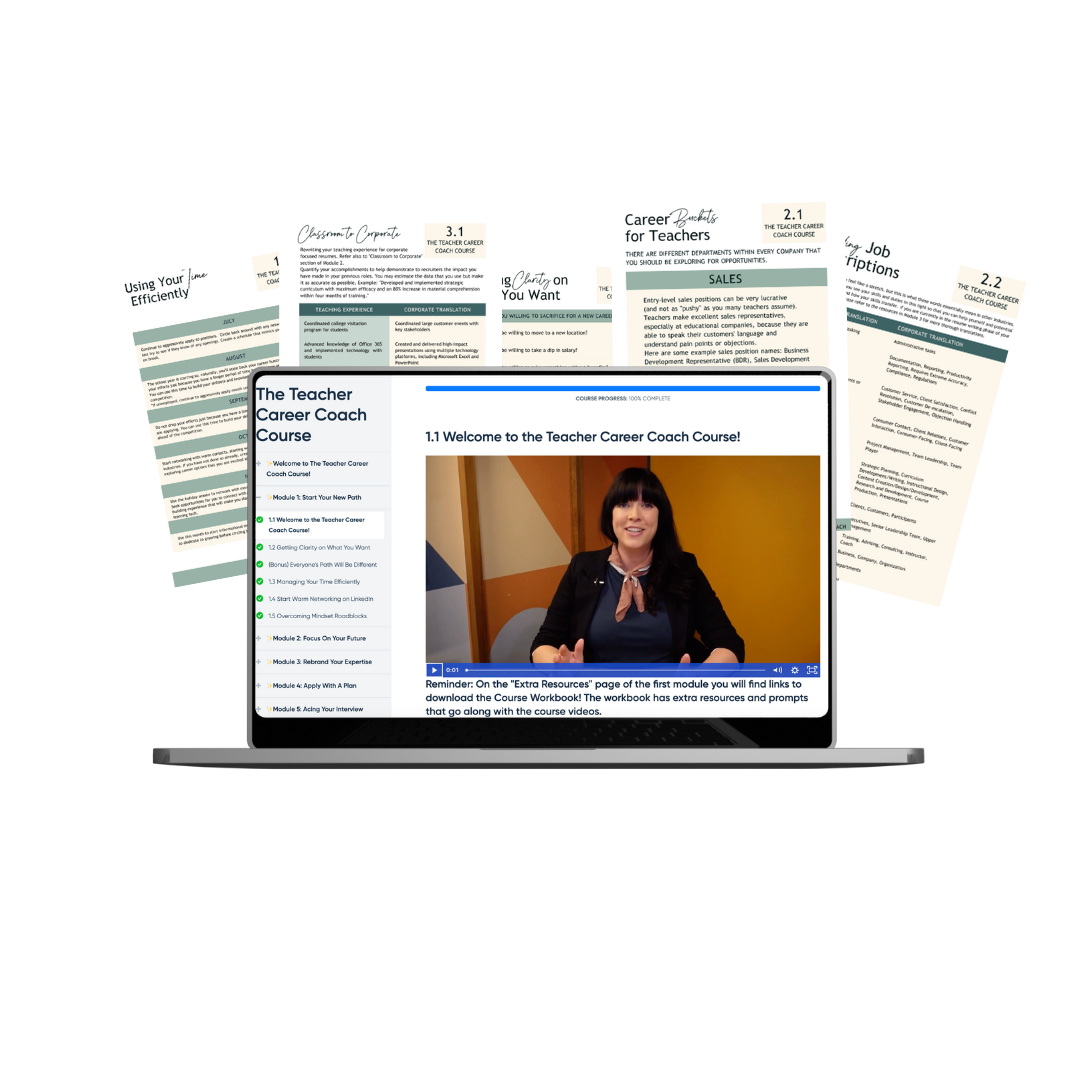
If you want help choosing a path and getting hired, the Teacher Career Coach Course walks you through every step: picking the right role for your numbers, translating your resume, networking and interviewing.